
 |
 |
|

|
A strong earthquake of 5.4 magnitude hits the city of Kalamata on March 1, 2004: First results Introduction On March 1, 2004 at 02:35 local time a moderate earthquake of 5.4 magnitude occurred in the Kalamata area (SW Peloponnesos). The epicentre was located 7km NE of the city of Kalamata at 7km focal depth and 13km North of the epicentre of the September 13, 1986 destructive earthquake, which damaged the city with magnitude 6.0 on the Richter Scale. It is interesting to note that the present earthquake was not followed by any significant aftershock activity. Some small magnitude events took place as they can be observed on the records of the local seismic station of the National Observatory of Athens Seismic Network at Ithomi (ITM). The largest aftershock occurred on March 2, 2004, at 08:20 local time with magnitude 3.8. ITM station is situated 20km West of the epicentre of the main event. Observed Damage
The reported damage is concentrated mainly on buildings in the city
centre of Kalamata (only one partial collapse of an old building
was reported) and on rock falls, which blocked the following main
roads: National Road Kalamata - Sparti between 11 and 24 km, Regional
Road Thouria - Dirachio 9 - 14 km, Kalamata - Eleochori 2 km
Seismic Processing Results The earthquake was well recorded at all digital broad band stations operated by the Institute of Geodynamics of the National Observatory of Athens. First results from spectral analysis show a 5.5 moment magnitude and a corner frequency of 0.6Hz (thus 5km fault length). Moment tensor inversion using three component broad band data from 7 stations (after Dreger 2002) resulted a normal fault mechanism of 348o strike, 50o dip and -92o rake. The solution has a value of Double Couple 89% and seismic moment 3,27E+23 dyn cm. Preliminary Conclusions A synthesis of the above mentioned results and a comparison with the estimations of other International Institutes, show that the earthquake occurred on a fault zone of NW-SE strike at the North-NorthEast of the city of Kalamata on a fault of about 5km long. The event did not occurred on the fault that ruptured during the 1986 damaging earthquake, but on a different smaller fault. Finally the present earthquake confirms the E-W extension regime, which is dominant in the Kalamata area as it has been proposed by Lyon-Caen et al. (1988) and Armijo et al. (1992). Neotectonic faulting in the broader area, localities of damages and rock falls, the epicentre of 1986 event and the first results of the present study are shown on the presented map. References Armijo, R., Lyon-Caen, H., & Papanastassiou, D. 1992. East-west extension and Holocene normal-fault scarps in the Hellenic arc, Geology, 20, 491-494. Dreger, D. S., 2002. Time-Domain Moment Tensor INVerse Code (TDMT_INVC) Version 1.1. User's Manual. Lyon-Caen, H., Armijo, R., Drakopoulos, J., Baskoutass, J., Delibassis, N., Gaulon, R., Kouskouna, V., Latoussakis, J., Makropoulos, K., Papadimitriou, P., Papanastassiou, D., & Pedotti, G., 1988. The 1986 Kalamata (south-Peloponnesus) earthquake - detailed study of a normal-fault, evidences for east-west extension in the Hellenic arc. J. Geophys. Res., 93, 14967-15000. Compiled by George N. Stavrakakis, Nicos S. Melis, Efthimios Sokos, Athanassios Ganas, Nicos Xanalatos and Costas Boukouras |
|||||||||||||||
|
 G.I.
homepage
G.I.
homepage STRUCTURE
 back
page
back
page 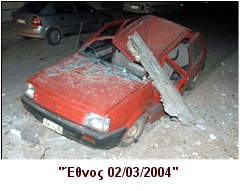
© 2001 National Observatory of Athens